
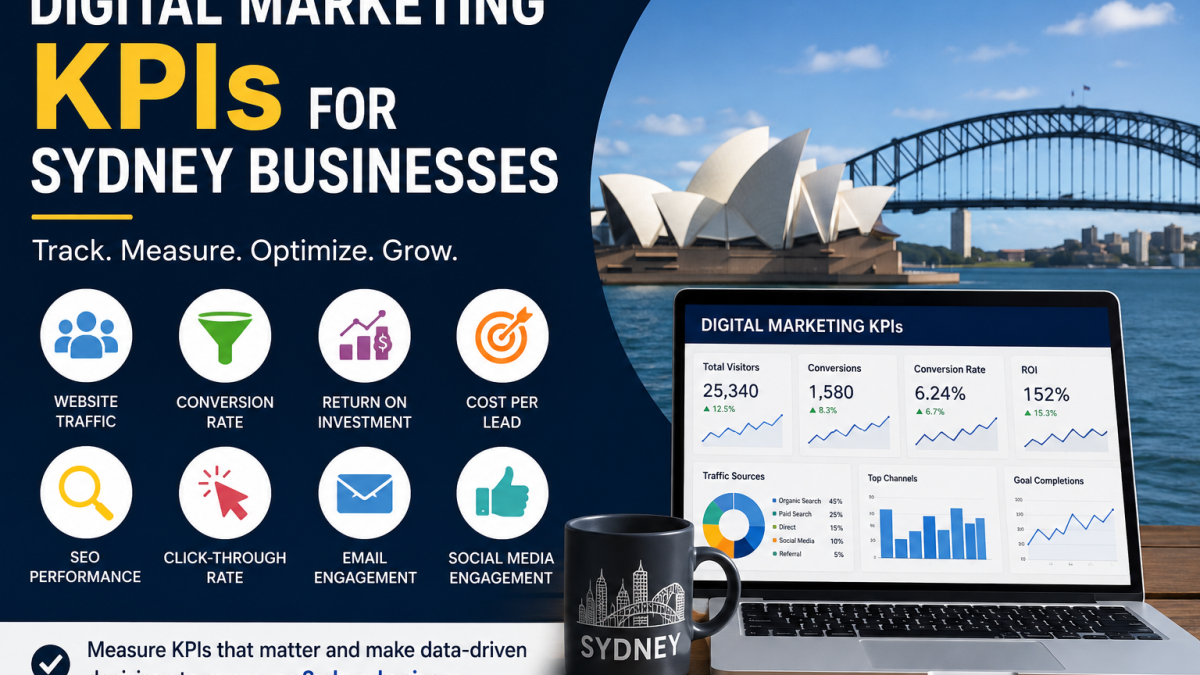
Digital Marketing KPIs for Sydney Businesses
In today’s competitive digital landscape, simply investing in online marketing isn’t enough. Sydney businesses need to measure the effectiveness of their campaigns to ensure every marketing dollar delivers value. This is where Digital Marketing KPIs (Key Performance Indicators) come into play. KPIs help businesses track performance, identify opportunities for improvement, and make data-driven decisions that lead to sustainable growth.
Whether you’re a small local business, an eCommerce store, or a growing enterprise in Sydney, understanding which digital marketing metrics matter most can significantly improve your return on investment (ROI). This guide explores the most important Digital Marketing KPIs for Sydney businesses and explains how to use them to strengthen your online presence.
Why Digital Marketing KPIs Matter
Digital marketing generates a wealth of data, but not every metric contributes to business success. KPIs focus on measurable outcomes that align with your goals, such as increasing website traffic, generating leads, boosting sales, or improving customer engagement.
Tracking the right KPIs helps businesses:
- Measure campaign performance accurately.
- Identify successful marketing channels.
- Allocate marketing budgets more effectively.
- Improve customer acquisition strategies.
- Increase conversions and revenue.
- Make informed business decisions based on real data.
Without clear KPIs, it’s difficult to determine whether your digital marketing efforts are producing meaningful results.
1. Website Traffic
Website traffic is one of the most fundamental digital marketing KPIs. It measures how many users visit your website over a specific period.
For Sydney businesses, increasing relevant website traffic often means reaching more local customers actively searching for products or services.
Key traffic metrics include:
- Total visitors
- New visitors
- Returning visitors
- Traffic by location
- Traffic by device
- Traffic sources
Rather than focusing solely on visitor numbers, analyze where your traffic originates. Organic search, paid advertising, social media, email marketing, and referrals each provide valuable insights into campaign performance.
2. Organic Search Traffic
Organic traffic represents visitors who find your website through search engines without clicking on paid advertisements.
For local businesses in Sydney, organic traffic is especially valuable because it attracts users with strong purchase intent.
Monitor:
- Organic sessions
- Keyword rankings
- Local search visibility
- Click-through rates
- Landing page performance
A steady increase in organic traffic often indicates successful SEO efforts and improved online visibility.
3. Conversion Rate
Generating website visitors is only valuable if those visitors take action.
Conversion rate measures the percentage of users who complete a desired goal, such as:
- Filling out a contact form
- Booking an appointment
- Purchasing a product
- Calling your business
- Signing up for a newsletter
The formula is:
Conversion Rate = (Conversions ÷ Total Visitors) × 100
Even a small improvement in conversion rate can significantly increase revenue without increasing marketing spend.
4. Cost Per Lead (CPL)
Cost Per Lead measures how much it costs to generate one qualified lead.
Formula:
Cost Per Lead = Total Marketing Spend ÷ Number of Leads
Sydney businesses running Google Ads, Facebook Ads, or LinkedIn campaigns should closely monitor CPL to ensure campaigns remain profitable.
Lower CPL often indicates more efficient marketing campaigns.
5. Customer Acquisition Cost (CAC)
Customer Acquisition Cost calculates the total expense required to gain a new customer.
It includes:
- Advertising costs
- Marketing software
- Agency fees
- Sales expenses
- Content marketing costs
Formula:
CAC = Total Marketing & Sales Costs ÷ New Customers Acquired
Reducing CAC while maintaining customer quality improves overall profitability.
6. Return on Investment (ROI)
ROI is one of the most important Digital Marketing KPIs for Sydney businesses because it directly measures profitability.
Formula:
ROI = (Revenue – Marketing Cost) ÷ Marketing Cost × 100
Positive ROI means your campaigns generate more revenue than they cost.
Businesses should calculate ROI separately for:
- SEO campaigns
- PPC advertising
- Email marketing
- Social media marketing
- Content marketing
This helps identify the most profitable channels.
7. Click-Through Rate (CTR)
CTR measures how often users click on your advertisement, email, or search result after seeing it.
Formula:
CTR = Clicks ÷ Impressions × 100
Higher CTR generally indicates:
- Strong ad copy
- Relevant keywords
- Effective meta titles
- Engaging calls-to-action
Improving CTR can increase website traffic without increasing advertising costs.
8. Bounce Rate
Bounce rate measures the percentage of visitors who leave your website after viewing only one page.
A high bounce rate may indicate:
- Slow website speed
- Poor user experience
- Irrelevant content
- Weak page design
- Confusing navigation
While bounce rate varies across industries, businesses should continually optimize website performance to keep visitors engaged.
9. Average Session Duration
Average session duration shows how long users spend on your website.
Longer sessions often suggest:
- Valuable content
- Better user engagement
- Strong website usability
Creating informative blogs, videos, FAQs, and helpful service pages encourages visitors to stay longer.
10. Lead-to-Customer Conversion Rate
Generating leads is only the first step.
Businesses should also monitor how many leads become paying customers.
Formula:
Lead-to-Customer Rate = Customers ÷ Leads × 100
Tracking this KPI helps identify weaknesses in the sales process and improves lead quality.
11. Email Marketing Performance
Email marketing remains one of the highest-performing digital marketing channels.
Important email KPIs include:
- Open Rate
- Click Rate
- Conversion Rate
- Unsubscribe Rate
- Bounce Rate
Segmented email campaigns generally achieve better engagement than generic newsletters.
12. Social Media Engagement
Social media success extends beyond follower counts.
Track engagement metrics such as:
- Likes
- Comments
- Shares
- Saves
- Reach
- Profile visits
- Website clicks
High engagement often reflects strong audience interest and effective content strategies.
13. Google Business Profile Performance
For Sydney businesses serving local customers, Google Business Profile metrics are essential.
Monitor:
- Profile views
- Website clicks
- Phone calls
- Direction requests
- Customer reviews
- Local search rankings
Optimizing your profile can significantly improve local visibility.
14. Customer Lifetime Value (CLV)
Customer Lifetime Value estimates how much revenue a customer generates throughout their relationship with your business.
Businesses with higher CLV can often afford greater customer acquisition costs while maintaining profitability.
Increasing customer retention through exceptional service and loyalty programs boosts CLV over time.
Best Tools for Tracking Digital Marketing KPIs
Successful businesses rely on analytics tools to monitor performance accurately.
Popular platforms include:
- Google Analytics 4
- Google Search Console
- Google Ads Dashboard
- Meta Ads Manager
- Google Business Profile Insights
- SEMrush
- Ahrefs
- HubSpot
- Microsoft Clarity
- Looker Studio
Combining data from multiple platforms provides a comprehensive view of marketing performance.
Common KPI Mistakes to Avoid
Many businesses track too many metrics without focusing on meaningful outcomes.
Avoid these common mistakes:
- Measuring vanity metrics instead of business goals.
- Ignoring conversion tracking.
- Failing to review KPIs regularly.
- Not setting realistic benchmarks.
- Overlooking mobile performance.
- Making decisions without sufficient data.
Regular reporting and continuous optimization ensure KPIs remain aligned with business objectives.
Internal Linking
- Complete Digital Marketing Guide for Sydney Startups
- How Content Marketing Helps Sydney Businesses Grow Online
- Top Social Media Marketing Trends Sydney Businesses Should Follow
Final Thoughts
Tracking the right Digital Marketing KPIs for Sydney businesses is essential for improving marketing performance and achieving long-term growth. Rather than relying on assumptions, businesses can use data-driven insights to optimize SEO, paid advertising, social media, email campaigns, and website performance.
By consistently monitoring metrics such as website traffic, conversion rate, customer acquisition cost, ROI, click-through rate, and customer lifetime value, Sydney businesses can make smarter marketing decisions and maximize their return on investment. As digital competition continues to grow, focusing on the right KPIs will help your business stay ahead, attract more qualified customers, and achieve sustainable success.