
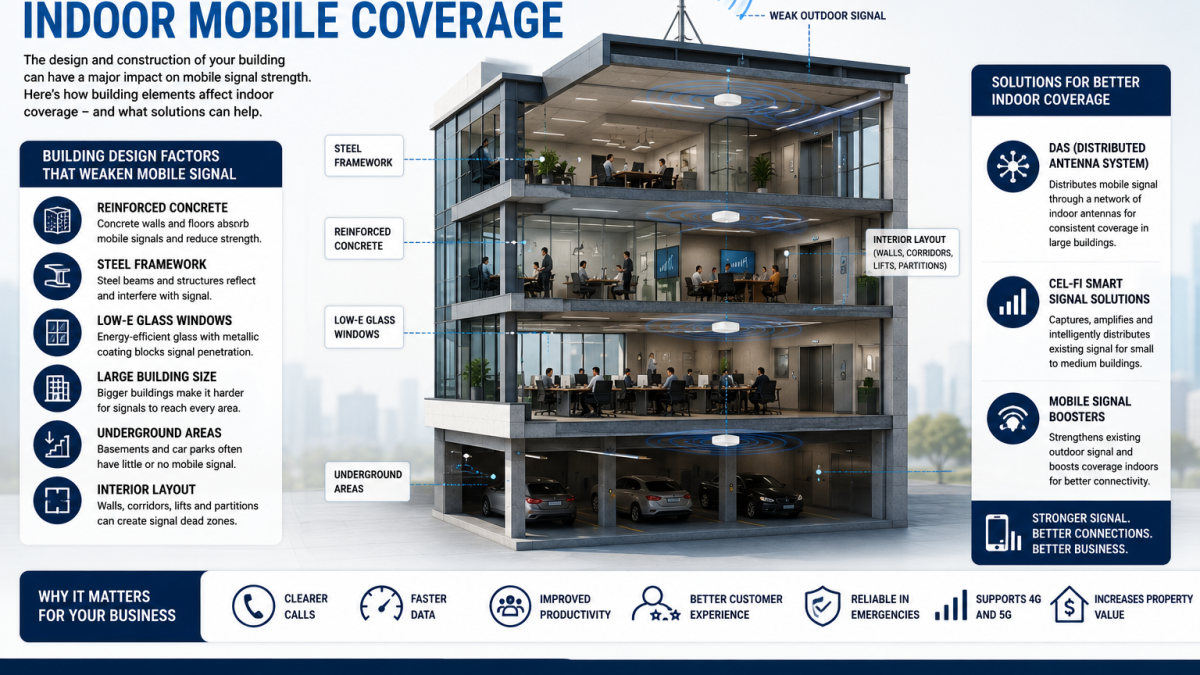
How Building Design Affects Indoor Mobile Coverage
Strong indoor mobile coverage is essential for today’s commercial buildings. Businesses rely on mobile connectivity for voice calls, video meetings, cloud-based applications, security systems, and customer communication. However, many building owners are surprised to learn that the design and construction of their property can have a significant impact on mobile signal strength.
Understanding Building Design Indoor Mobile Coverage is the first step towards creating a workplace where employees, customers, and visitors can stay connected without interruptions. From construction materials to building layout, several design elements influence how well mobile signals travel throughout a building.
In this guide, we’ll explore how building design affects indoor mobile coverage, the most common causes of weak reception, and the solutions available to improve connectivity.
Why Indoor Mobile Coverage Matters
Reliable indoor mobile coverage is more than a convenience—it’s an essential part of modern business operations.
Strong mobile connectivity helps businesses:
- Make clear voice calls
- Access cloud-based applications
- Support hybrid and remote work
- Improve customer communication
- Enable mobile payment systems
- Increase workplace productivity
- Enhance safety during emergencies
When indoor coverage is poor, businesses may experience dropped calls, slow mobile data, and communication delays that affect daily operations.
How Building Design Impacts Mobile Signal
Mobile signals travel using radio frequencies. As these signals enter a building, they must pass through walls, windows, ceilings, and other structural elements. Certain materials and building designs weaken or block these signals, creating indoor dead zones.
Here are the main design factors that affect indoor mobile coverage.
1. Reinforced Concrete Walls
Concrete is one of the biggest barriers to mobile signals.
Modern commercial buildings often use reinforced concrete for structural strength, but thick concrete walls and floors absorb radio frequency signals, making it difficult for them to reach interior spaces.
The more concrete between your phone and the outdoor mobile tower, the weaker the signal becomes.
2. Steel Framework
Steel beams, columns, and roof structures can reflect and interfere with mobile signals.
Large office buildings, warehouses, factories, and industrial facilities often contain significant amounts of structural steel, increasing the likelihood of poor indoor reception.
This is one of the most common reasons why businesses experience strong signal outdoors but weak coverage inside.
3. Low-E Glass Windows
Energy-efficient buildings commonly use Low-Emissivity (Low-E) glass to reduce heat transfer and improve energy performance.
While this technology lowers heating and cooling costs, the metallic coating applied to the glass also reduces the strength of mobile signals entering the building.
As more commercial buildings adopt energy-efficient designs, indoor mobile coverage challenges have become increasingly common.
4. Building Size
Larger buildings naturally present greater challenges for mobile coverage.
Even if the outdoor signal is strong, it may not reach every floor, meeting room, or office without additional infrastructure.
Large properties that often require dedicated coverage solutions include:
- Corporate offices
- Shopping centres
- Hospitals
- Hotels
- Universities
- Warehouses
- Multi-storey office buildings
5. Underground Areas
Basements are among the most difficult locations for mobile reception.
Areas such as:
- Basement car parks
- Storage facilities
- Plant rooms
- Service corridors
often receive little or no direct signal from nearby mobile towers because they are below ground level and surrounded by concrete.
6. Interior Layout
The internal design of a building also affects signal distribution.
Features such as:
- Multiple meeting rooms
- Long corridors
- Internal partitions
- Lift shafts
- Stairwells
can all create obstacles that weaken or block mobile signals as they travel through the building.
Poor layout planning can result in dead zones even when outdoor coverage is excellent.
Common Signs Building Design Is Affecting Your Mobile Coverage
If your building design is limiting mobile signal, you may notice:
- Dropped phone calls
- Weak signal indoors
- Better reception outside than inside
- Slow mobile internet
- Dead zones in meeting rooms
- Poor reception near lifts
- No signal in basement areas
- Employees moving around to find better reception
These signs usually indicate that the issue lies with the building rather than the mobile network provider.
Industries Most Affected
Many industries depend on reliable indoor mobile connectivity to support daily operations.
Buildings that commonly experience indoor mobile coverage challenges include:
- Commercial offices
- Healthcare facilities
- Hotels
- Retail stores
- Shopping centres
- Warehouses
- Educational institutions
- Government buildings
- Apartment complexes
For these environments, improving indoor mobile coverage can enhance communication, customer service, and operational efficiency.
How to Improve Indoor Mobile Coverage
If your building’s design is affecting mobile reception, there are several proven solutions that can significantly improve indoor connectivity. The right option depends on your building’s size, construction materials, layout, and the strength of the outdoor mobile signal.
Distributed Antenna System (DAS)
A Distributed Antenna System (DAS) is one of the most effective solutions for large commercial buildings. It distributes mobile signals through a network of strategically placed indoor antennas, providing consistent coverage across multiple floors and large indoor spaces.
DAS is ideal for:
- Corporate office buildings
- Hospitals
- Hotels
- Shopping centres
- Universities
- Airports
- Industrial facilities
For large properties with hundreds of users, DAS delivers reliable voice calls and faster mobile data throughout the building.
CEL-FI Smart Signal Solutions
For small and medium-sized commercial buildings, CEL-FI systems offer an intelligent way to improve indoor mobile reception.
These systems capture the existing outdoor signal, amplify it, and distribute stronger coverage inside the building.
CEL-FI solutions are suitable for:
- Offices
- Medical clinics
- Retail stores
- Professional suites
- Small warehouses
Benefits include:
- Clearer voice calls
- Faster mobile data
- Reduced dropped calls
- Better indoor signal quality
Commercial Mobile Signal Boosters
Commercial-grade mobile signal boosters are another effective solution when a usable outdoor signal already exists.
Professionally installed boosters improve mobile reception by strengthening the available signal and redistributing it throughout the building.
They are commonly used in:
- Small offices
- Retail businesses
- Cafés
- Apartment buildings
- Small commercial premises
Professional installation is essential to ensure optimal performance and compliance with Australian telecommunications regulations.
Why a Professional Site Survey Is Essential
Every building is different, which is why a professional site survey is the first step in improving indoor mobile coverage.
During the survey, technicians assess:
- Existing indoor and outdoor signal strength
- Building construction materials
- Floor plans and layouts
- High-priority coverage areas
- Number of mobile users
- Sources of signal interference
The results help determine whether your building is best suited to a DAS, CEL-FI system, or commercial mobile signal booster.
Benefits of Improving Indoor Mobile Coverage
A professionally designed solution offers long-term advantages for businesses.
Key benefits include:
- Stronger mobile signal across the building
- Clearer voice calls
- Faster mobile internet
- Improved employee productivity
- Better customer experience
- Fewer communication interruptions
- Reliable coverage in meeting rooms and common areas
- Enhanced support for 4G and 5G networks
- Increased property value and tenant satisfaction
Reliable connectivity helps businesses operate more efficiently while supporting modern workplace technology.
Why Choose Digital Sydney Communications?
Digital Sydney Communications specialises in professional indoor mobile coverage solutions for commercial buildings across Sydney.
Our services include:
- In-Building Coverage (IBC)
- Distributed Antenna System (DAS) installation
- CEL-FI mobile signal solutions
- Commercial mobile signal boosters
- Mobile signal site surveys
- Walk testing
- Sweep testing
- Passive Intermodulation (PIM) testing
- Commercial WiFi installation
Our experienced team works with businesses across a wide range of industries, designing tailored solutions that improve indoor connectivity and support long-term performance.
Frequently Asked Questions
Why does my building have poor indoor mobile coverage?
Modern buildings often use reinforced concrete, steel, and Low-E glass, all of which reduce the strength of mobile signals entering the property.
Can building design really affect 5G signals?
Yes. While 5G provides faster speeds, its higher-frequency signals can be more affected by building materials and obstacles, making professional indoor coverage solutions increasingly important.
Which buildings benefit most from indoor mobile coverage systems?
Commercial offices, hospitals, hotels, shopping centres, warehouses, apartment buildings, and educational facilities all benefit from improved indoor mobile connectivity.
Is a site survey necessary before installation?
Yes. A professional survey identifies the cause of poor coverage and helps determine the most suitable solution for your building.
How long does installation take?
The installation timeframe depends on the size and complexity of the building. After the site survey, you’ll receive a detailed project plan and estimated completion schedule.
Internal Linking
Link to Service Pages
Link to Related Blog Posts
- How to Eliminate Mobile Dead Zones in Commercial Buildings
- Office Mobile Phone Reception Sydney
- Why Your Commercial Building Needs a DAS
- DAS vs CEL-FI: Which Mobile Coverage Solution Do You Need?
Conclusion
Building design plays a major role in determining the quality of indoor mobile reception. Reinforced concrete, steel structures, energy-efficient glass, large floor plans, and underground areas can all contribute to weak signal strength and frustrating mobile dead zones.
Understanding how Building Design Indoor Mobile Coverage is affected by these factors allows businesses to choose the right solution before communication problems begin to impact productivity and customer service.
Whether your building requires a Distributed Antenna System (DAS), a CEL-FI smart signal solution, or a commercial mobile signal booster, investing in professional in-building coverage ensures reliable connectivity for employees, visitors, and customers.
Digital Sydney Communications provides tailored indoor mobile coverage solutions across Sydney, helping businesses overcome signal challenges with expert design, installation, testing, and ongoing support.