
Indoor mobile coverage solutions
Mobile Signal Booster Sydney
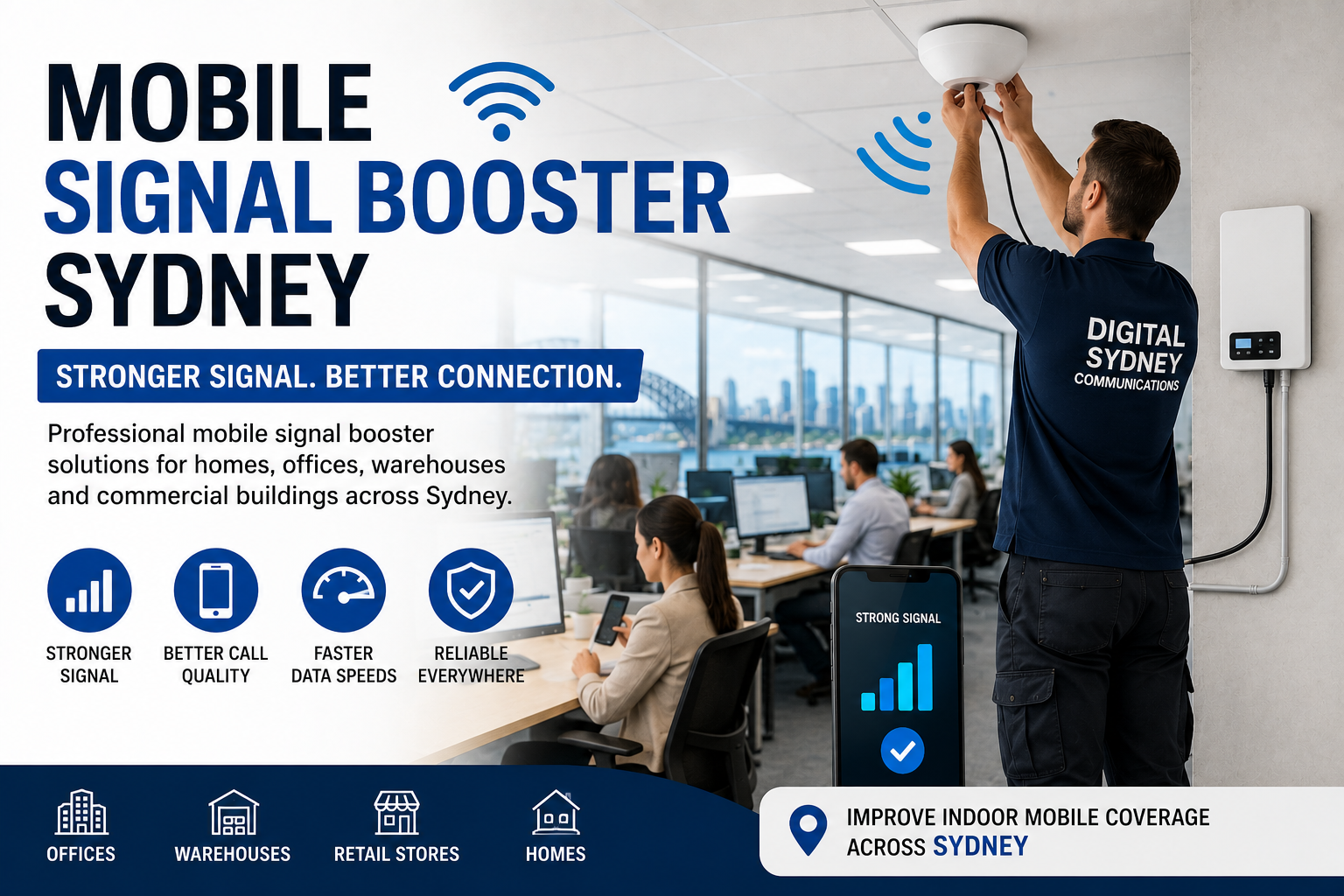
Weak indoor mobile reception can disrupt calls, mobile data and everyday operations. Digital Sydney Communications assesses coverage problems and delivers site-specific CEL-FI, authorised mobile repeater and in-building coverage solutions for homes, offices and commercial properties across Sydney.
Why mobile signal becomes weak inside buildings
A phone can receive a strong signal outdoors but struggle inside the same property. The building itself is often the cause. Dense materials, enclosed areas and distance from the nearest mobile site can reduce the signal before it reaches the rooms where people need to use it.
Every Mobile Signal Booster Sydney enquiry begins with understanding the available outdoor signal, the required mobile network and the areas inside the property that need improved coverage.
Concrete and steel
Reinforced concrete, structural steel and thick masonry can significantly reduce signal penetration.
Performance glazing
Low-emissivity and energy-efficient glass can limit the mobile signal entering a building.
Enclosed areas
Basements, car parks, lift lobbies and internal rooms are often separated from reliable outdoor coverage.
Building size and layout
Multiple levels, large floorplates and complex layouts can create inconsistent coverage and indoor dead zones.
Common symptoms include dropped calls, slow mobile data, delayed messages, low signal bars and reception that improves as soon as you step outside.
Mobile Signal Booster Sydney: what the term means in Australia
People often use “mobile signal booster” as a general term for equipment that improves indoor reception. Australian regulations make an important distinction: mobile phone boosters are prohibited, while cellular mobile repeaters can only be operated when authorised under the applicable carrier requirements.
An authorised repeater solution may take an available outdoor mobile signal and distribute improved coverage through an indoor area. An installation can include an external donor antenna, approved signal-processing equipment, indoor coverage antennas and connecting cabling.
Before selecting equipment, read the Australian Communications and Media Authority guidance on mobile phone boosters and authorised repeaters . The appropriate equipment depends on the available signal, mobile network, carrier authorisation, building and required coverage area.
Benefits of professionally planned indoor mobile coverage
More reliable calls
Improved indoor signal can reduce call dropouts and make voice communication more consistent in the planned coverage area.
Improved mobile data
A suitable system can improve access to mobile data where weak indoor reception is the limiting factor.
Fewer indoor dead zones
Coverage can be planned around priority areas such as offices, meeting rooms, retail floors, warehouses and car parks.
For a Mobile Signal Booster Sydney project, the assessment should identify whether an authorised cellular repeater, CEL-FI system or broader DAS solution is appropriate.
Where an authorised mobile repeater may be assessed
Authorised repeater and other mobile coverage solutions can be assessed for a wide range of properties, including:
- Homes and home offices
- Commercial offices and meeting areas
- Retail stores and hospitality venues
- Warehouses and industrial facilities
- Medical clinics and aged-care environments
- Hotels and accommodation
- Basements, car parks and enclosed internal areas
The appropriate solution is determined by the property size, construction, existing signal, carrier requirements and areas that need coverage.
Authorised mobile repeater or distributed antenna system?
A targeted authorised repeater solution and a distributed antenna system serve different project needs. Neither should be selected solely from the building type or floor area.
CEL-FI and targeted coverage
CEL-FI may suit homes, smaller workplaces or defined areas with a specific indoor coverage problem. The suitable model, network, carrier requirements and antenna arrangement must be confirmed for the site.
Learn about CEL-FI installationDAS and building-wide coverage
A distributed antenna system may be considered for larger or more complex buildings, multiple levels, extensive internal areas or projects with broader carrier and capacity requirements.
Explore DAS and in-building coverageA site assessment helps define the coverage problem and determine which approach should progress to design and quotation.
Our indoor mobile coverage installation process
-
01
Site survey and signal assessment
We review the existing mobile signal, priority coverage areas, building construction, available plans and practical installation constraints.
-
02
Solution selection and planning
Based on the survey, we define the recommended equipment, antenna locations, cable routes and intended coverage areas. A CEL-FI solution or broader DAS approach may be considered depending on the findings.
-
03
Installation and setup
Our team installs the approved equipment and cabling, configures the system and coordinates the work around the site and project requirements.
-
04
Testing and handover
We test the installed coverage and complete the agreed commissioning and handover records. The exact tests and documentation depend on the approved project scope.
Why use an experienced mobile coverage installer?
Indoor coverage work involves more than installing an antenna and amplifier. The system must be selected and positioned around the available signal, intended mobile network, required carrier authorisation, isolation between antennas, building layout and planned coverage areas.
Digital Sydney Communications provides site surveys, CEL-FI installation, DAS and in-building coverage, RF walk testing, call testing, PIM testing, sweep testing and commissioning where applicable to the project scope.
- Site-specific recommendations rather than a one-size-fits-all package
- Professional equipment installation and cable routing
- Testing against the agreed coverage objectives
- Commissioning and handover documentation where included
Mobile signal booster FAQs
Are mobile signal boosters legal in Australia?
ACMA states that mobile phone boosters are prohibited. Cellular mobile repeaters are different and require the applicable carrier authorisation. Always confirm that the proposed equipment and its use meet current Australian requirements.
What happens during a Mobile Signal Booster Sydney assessment?
Yes. A site survey identifies the available signal, coverage problem, priority areas and installation constraints before equipment is recommended.
Is CEL-FI suitable for a commercial building?
CEL-FI may suit some commercial sites or defined coverage areas. Larger or more complex buildings may require a DAS or another in-building coverage approach. The decision should follow a site assessment.
Can a repeater improve coverage in a basement car park?
Coverage can be designed for basements and car parks where the survey confirms a suitable signal source and a practical, authorised system design. Suitability cannot be confirmed without assessing the site.
Can one system support every mobile network?
Carrier support depends on the selected equipment, available source signals, carrier requirements and project scope. The required mobile networks should be identified during the initial assessment.
How is the improved coverage tested?
The installed system is tested against the agreed project requirements. Depending on the scope, this may include signal measurements, RF walk testing, call testing and commissioning records.
Discuss your coverage problem
Request a mobile coverage assessment and quotation
Tell us the site location, building type, mobile network and areas with weak reception. The team can review the appropriate next step.