
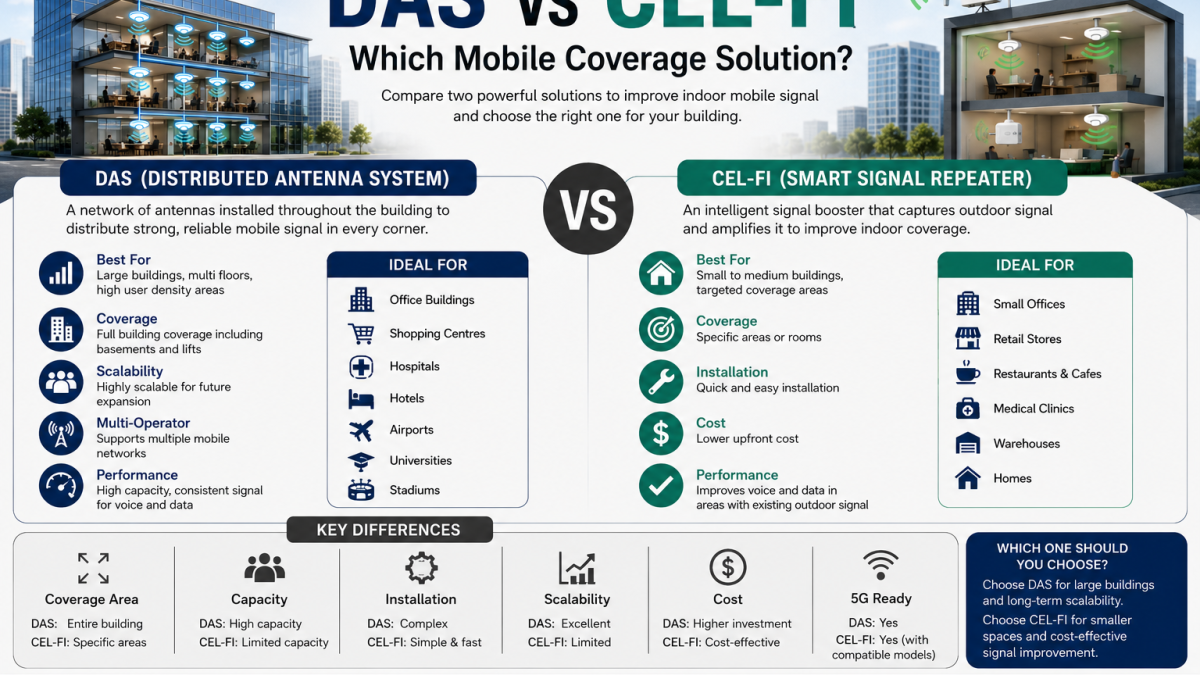
DAS vs CEL-FI: Which Mobile Coverage Solution Do You Need?
Poor mobile signal inside a building can quickly become a frustrating problem. Dropped calls, slow internet, and unreliable connectivity affect employees, customers, tenants, and visitors every day. Whether you manage an office building, shopping centre, warehouse, hotel, hospital, or apartment complex, reliable indoor mobile coverage has become an essential part of running a modern property.
If you’re researching ways to improve signal strength, you’ve probably come across two popular solutions: Distributed Antenna Systems (DAS) and CEL-FI smart signal repeaters. Both are designed to improve indoor mobile coverage, but they work differently and are suited to different types of buildings.
So, DAS vs CEL-FI: Which Mobile Coverage Solution Do You Need? The answer depends on your building size, coverage requirements, budget, and long-term plans. In this guide, we’ll explain how each system works, compare their advantages and limitations, and help you choose the right solution for your property.
Why Indoor Mobile Coverage Matters
Today’s businesses rely on mobile connectivity for almost every aspect of daily operations. Employees use smartphones for calls, emails, messaging apps, video meetings, and cloud-based collaboration. Customers expect strong signal when they visit your premises, while tenants often consider reliable mobile reception a basic requirement.
Poor indoor coverage can lead to:
- Dropped phone calls
- Slow mobile data
- Missed business opportunities
- Poor customer experience
- Reduced employee productivity
- Communication issues during emergencies
Investing in the right mobile coverage solution not only improves communication but also enhances your building’s value and user experience.
What Is a Distributed Antenna System (DAS)?
A Distributed Antenna System (DAS) is a professionally designed network of indoor antennas connected to a central signal source. Instead of relying solely on outdoor mobile towers, a DAS distributes mobile signals evenly throughout a building.
The system typically includes:
- Signal source
- Head-end equipment
- Fibre optic or coaxial cabling
- Indoor antennas
- Signal amplifiers
- Network monitoring equipment
Because antennas are strategically installed throughout the property, users receive strong and consistent coverage in areas where mobile signals would normally be weak or unavailable.
A DAS is commonly installed in:
- Commercial office buildings
- Shopping centres
- Hospitals
- Hotels
- Airports
- Universities
- Stadiums
- Warehouses
- Large apartment complexes
For medium to large buildings, a DAS is considered one of the most reliable long-term solutions for indoor mobile coverage.
What Is CEL-FI?
CEL-FI is an intelligent mobile signal repeater designed to improve indoor reception without installing a full Distributed Antenna System.
A CEL-FI solution usually consists of:
- An external donor antenna
- A network unit
- One or more indoor coverage units
The donor antenna captures an existing outdoor mobile signal and the system intelligently amplifies and redistributes it indoors.
Unlike traditional repeaters, CEL-FI systems are designed to enhance signal quality while reducing interference, making them suitable for many residential and small commercial applications.
CEL-FI is commonly used in:
- Small offices
- Retail stores
- Medical clinics
- Restaurants
- Residential homes
- Small warehouses
- Small apartment buildings
It’s often a faster and more cost-effective option where only a limited coverage area needs improvement.
DAS vs CEL-FI: Key Differences
Although both solutions improve mobile reception, they are designed for different environments.
| Feature | DAS | CEL-FI |
|---|---|---|
| Best for | Large commercial buildings | Small to medium buildings |
| Coverage Area | Entire building | Specific areas or rooms |
| Scalability | Excellent | Limited |
| Supports Multiple Operators | Yes (depending on design) | Usually one operator per system |
| Installation Complexity | High | Low to moderate |
| Future Expansion | Easy | Limited |
| Initial Investment | Higher | Lower |
The right solution depends on your building’s size, the number of users, and your long-term connectivity requirements.
When a DAS Is the Better Choice
A Distributed Antenna System is generally recommended when your building has:
- Multiple floors
- Hundreds of occupants
- Underground car parks
- Large open floor plans
- Consistent signal problems throughout the property
- Multiple mobile network users
A professionally designed DAS delivers reliable coverage across the entire building and supports future technologies such as 5G.
Although the initial investment is higher, many businesses find that the long-term performance and scalability justify the cost.
When CEL-FI Is the Better Choice
CEL-FI is ideal when the mobile signal problem is limited to a smaller area.
It works well for:
- Small offices
- Retail shops
- Residential homes
- Cafés
- Medical practices
- Small commercial units
If your outdoor signal is already reasonable but weak indoors, CEL-FI can significantly improve reception without the complexity of a full DAS installation.
It’s also a good option for businesses looking for a quicker and more affordable solution.
Factors to Consider Before Choosing
Before deciding between DAS and CEL-FI, ask yourself:
- How large is the building?
- How many people use the building each day?
- Which mobile operators need support?
- Do you need coverage in underground areas?
- Are you planning future building expansions?
- Is 5G compatibility important?
A professional site survey can answer these questions and help determine the most suitable solution based on your property’s unique requirements.
Pros and Cons of a Distributed Antenna System (DAS)
A Distributed Antenna System is one of the most effective ways to improve indoor mobile coverage, particularly in medium and large commercial buildings. While it requires a greater initial investment, it delivers long-term performance and scalability.
Advantages of DAS
- Provides consistent mobile coverage throughout large buildings
- Supports multiple floors and underground car parks
- Can be designed to work with multiple mobile network operators
- Delivers reliable voice calls and high-speed mobile data
- Supports 4G and 5G technologies
- Scalable for future building expansions
- Ideal for high-density environments such as offices, hospitals, shopping centres, and airports
Considerations
- Higher installation cost than smaller coverage solutions
- Requires professional design, testing, and installation
- Installation time may be longer for complex buildings
For organisations planning long-term growth, a DAS is often the most reliable and future-ready solution.
Pros and Cons of CEL-FI
CEL-FI systems are designed to improve indoor mobile reception where an outdoor signal already exists but becomes weak inside the building. They are a practical solution for smaller properties and targeted coverage areas.
Advantages of CEL-FI
- Faster installation
- Lower upfront cost
- Excellent for small offices and retail spaces
- Intelligent signal amplification with minimal interference
- Compact and easy to integrate into existing buildings
- Suitable for homes and small commercial properties
Considerations
- Best suited for smaller coverage areas
- May support only one mobile operator per system configuration
- Not designed for very large or complex commercial buildings
- Limited scalability compared with a DAS
If your building only has a few weak-signal areas, CEL-FI can provide an efficient and cost-effective improvement.
DAS or CEL-FI: Which Solution Is Right for You?
There is no one-size-fits-all answer. The best choice depends on your building’s size, layout, occupancy, and future requirements.
A Distributed Antenna System (DAS) is usually the better choice if you have:
- A multi-storey office building
- A shopping centre
- A hospital or healthcare facility
- A hotel
- A university campus
- An airport
- Underground parking levels
- Hundreds of daily occupants
A CEL-FI solution is often the better option if you have:
- A small office
- A retail shop
- A café or restaurant
- A medical clinic
- A home office
- A warehouse with only a few weak-signal areas
The most reliable way to choose the right solution is through a professional mobile coverage assessment.
Why Professional Installation Matters
Even the best equipment will not perform properly if it is poorly installed.
Professional engineers assess:
- Existing signal strength
- Building construction materials
- Coverage requirements
- Mobile network compatibility
- Antenna placement
- Potential interference sources
After installation, testing ensures the system delivers reliable performance throughout the property.
This approach reduces future maintenance issues and helps maximise your investment.
Why Choose Digital Sydney Communications?
Digital Sydney Communications specialises in improving indoor mobile coverage for commercial, industrial, healthcare, education, hospitality, and residential buildings across Sydney.
Our team provides:
- Distributed Antenna System (DAS) installation
- CEL-FI installation and configuration
- In-building mobile coverage solutions
- Mobile signal surveys
- Walk testing
- Sweep testing
- Passive Intermodulation (PIM) testing
- Commercial WiFi solutions
- Telecommunications infrastructure services
Every project begins with a detailed site assessment, allowing us to recommend the most effective solution based on your building, budget, and operational requirements.
Frequently Asked Questions
Is DAS better than CEL-FI?
Neither solution is universally better. DAS is ideal for large commercial buildings, while CEL-FI is often the best choice for smaller properties with limited coverage issues.
Does CEL-FI work without an outdoor signal?
No. CEL-FI requires an existing outdoor mobile signal to capture and amplify. If there is little or no usable outdoor signal, a different solution may be required.
Can a DAS support 5G?
Yes. Modern Distributed Antenna Systems are designed to support both 4G LTE and 5G networks, making them a future-ready investment.
How do I know which solution my building needs?
A professional mobile coverage survey is the most accurate way to determine whether a DAS or CEL-FI system is the right fit.
How long does installation take?
The installation timeframe depends on the size and complexity of the project. Smaller CEL-FI installations can often be completed quickly, while larger DAS projects require more planning and installation time.
Conclusion
When comparing DAS vs CEL-FI: Which Mobile Coverage Solution Do You Need?, the right answer depends on your building and your connectivity goals. If you manage a large commercial property with multiple floors, high occupancy, or underground parking, a Distributed Antenna System offers the most reliable, scalable, and future-ready solution. If you need to improve signal in a smaller office, retail space, or residential property, CEL-FI can provide an effective and cost-efficient alternative.
Choosing the right solution starts with understanding your building’s current mobile coverage. A professional site survey identifies weak-signal areas and helps determine the best technology for your needs. With expert advice and the right installation, you can eliminate dropped calls, improve data performance, and create a better experience for everyone who uses your building.